
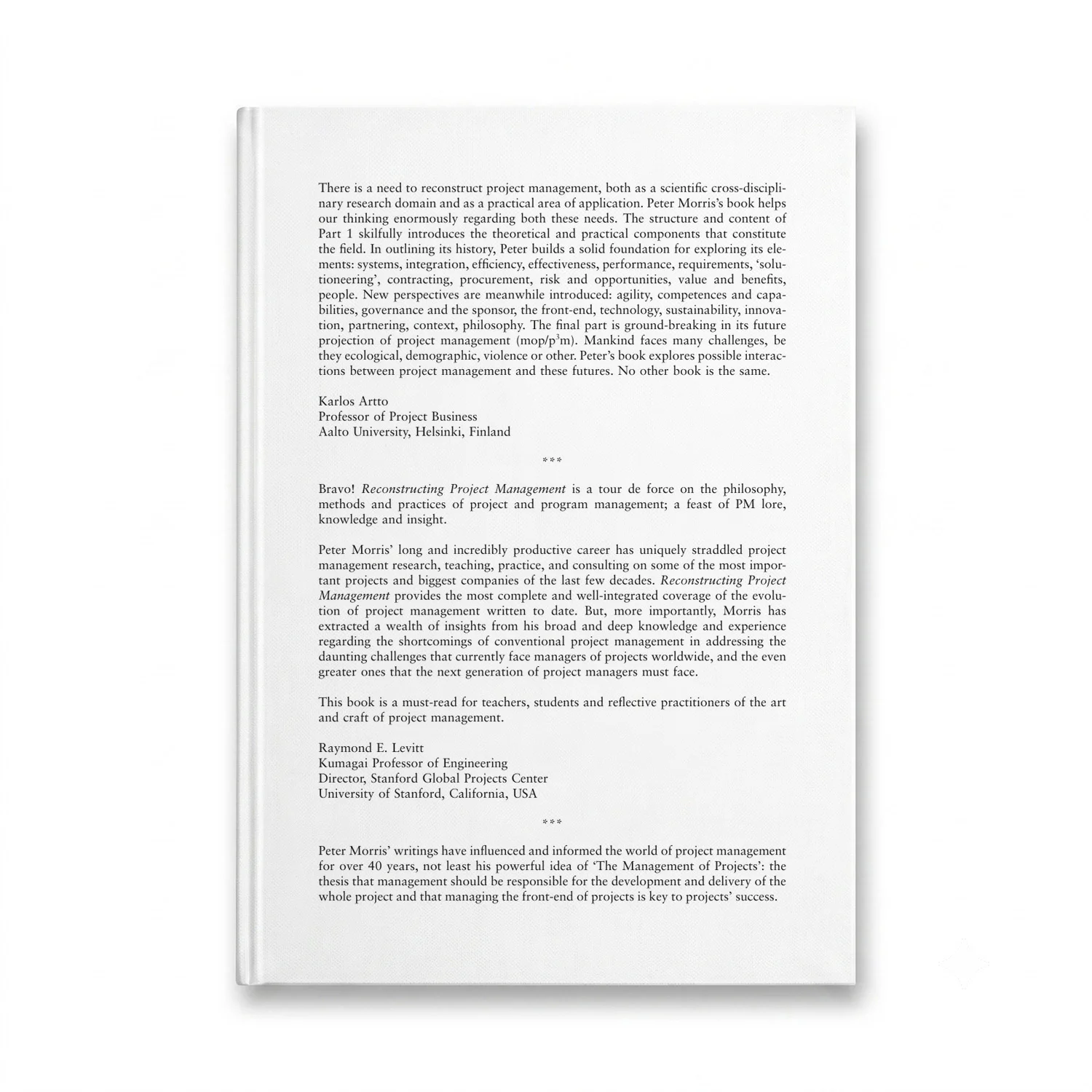

This hugely informative and wide-ranging analysis on the management of projects, past, present, and future, is written both for practitioners and scholars. Beginning with a history of the discipline’s development, Reconstructing Project Management provides an extensive commentary on its practices and theoretical underpinnings, and concludes with proposals to improve its relevance and value. Written not without a hint of attitude, this is by no means simply another project management textbook.
The thesis of the book is that ‘it all depends on how you define the subject’; that much of our present thinking about project management as traditionally defined is sometimes boring, conceptually weak, and of limited application, whereas in reality it can be exciting, challenging, and enormously important. The book draws on leading scholarship and case studies to explore this thesis.
The book is divided into three major parts. Following an Introduction setting the scene, Part 1 covers the origins of modern project management – how the discipline has come to be what it is typically said to be; how it has been constructed – and the limitations of this traditional model. Part 2 presents an enlarged view of the discipline and then deconstructs this into its principal elements. Part 3 then reconstructs these elements to address the challenges facing society, and the implications for the discipline, in the years ahead. A final section reprises the sweep of the discipline’s development and summarises the principal insights from the book.
Published by Wiley-Blackwell on June 4, 2013, with ISBN-13: 978-0470659076, this volume offers a fresh perspective on project management that is essential reading for anyone involved in managing projects or researching the field.
Read more