
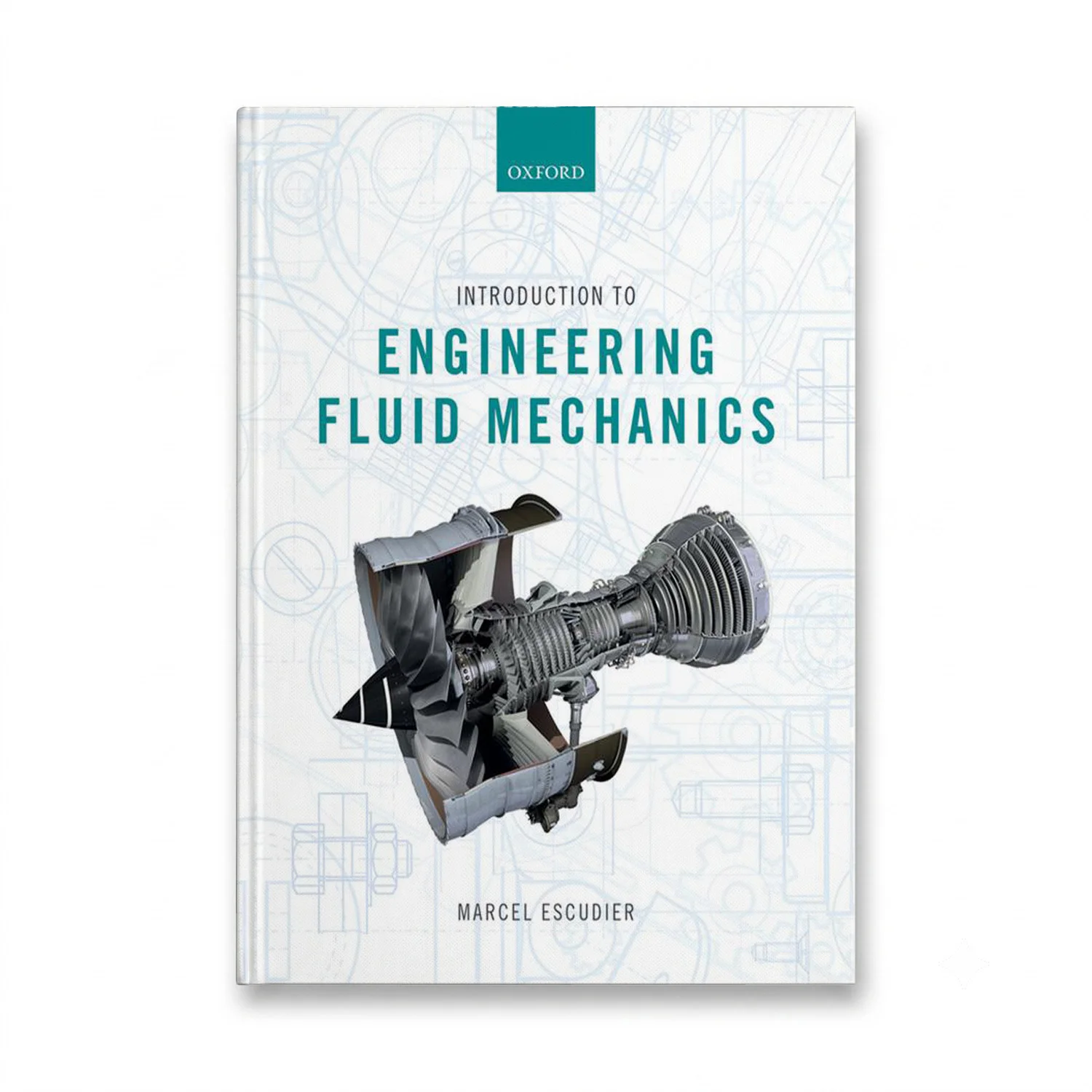

Introduction to Engineering Fluid Mechanics by Escudier (Author) delves into the fundamental principles and practical applications of fluid mechanics, essential for understanding the behavior of fluids in various engineering contexts. This illustrated edition is published by Oxford University Press and was released on November 9, 2017. Spanning 608 pages, the book explores a wide array of topics, from basic concepts to advanced theories, making it suitable for both introductory and advanced courses.
The text covers the dynamics of fluids including air, water, steam, and synthetic fluids, providing insights into how these substances respond under different conditions. It is particularly valuable for students in mechanical engineering, chemical engineering, aeronautical engineering, aerospace engineering, and civil engineering, as it integrates theoretical knowledge with real-world applications.
The first ten chapters are ideal for first-year undergraduate courses, while the latter half delves into more advanced topics suitable for upper-level students. The author emphasizes practical examples such as calculating jet engine thrust, analyzing shock- and expansion-wave patterns in supersonic flow, assessing forces due to liquid flow through pipe bends or junctions, and evaluating gas turbine power output.
Key features of the book include a focus on underlying physics rather than complex mathematical derivations. The text places significant emphasis on dimensional analysis and includes extensive material on non-Newtonian fluids—a crucial aspect given that most synthetic liquids exhibit non-Newtonian behavior. This makes the book a comprehensive resource for anyone interested in mastering the principles of engineering fluid mechanics.