
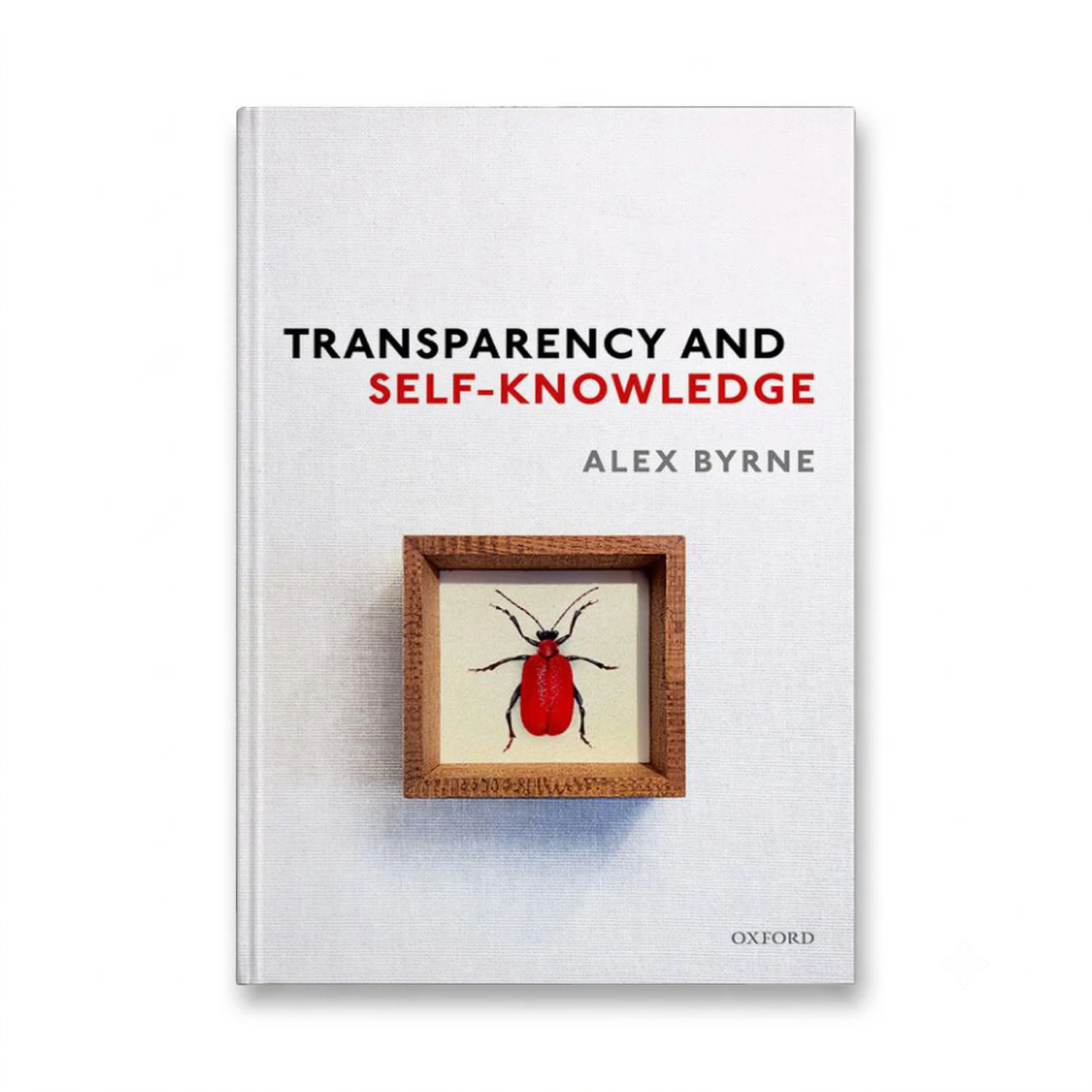

Transparency and Self-Knowledge
Author: Alex Byrne
Publisher: Oxford University Press
Publish Date: October 31, 2022
Print Length: 240 pages
In this thought-provoking work, Alex Byrne presents and defends a novel theory of self-knowledge—knowledge of one’s own mental states. Inspired by Gareth Evans’ discussion in “The Varieties of Reference,” the core idea is that self-knowledge is achieved through an inference from worldly or environmental premises to conclusions about one’s mental state M. The mind, on this account, is ‘transparent,’ allowing self-knowledge to be gained via an ‘outward glance’ rather than an ‘inward glance.’
Belief serves as the clearest example, with Byrne proposing that knowledge of belief can be inferred from premises like “p” (e.g., seeing a sign saying “Stop”). Yet, these inferences face significant challenges. For instance, it is often argued that “p” provides at best very weak evidence for believing that p. Additionally, the theory struggles to explain self-knowledge in cases such as intention (“I intend to do this”) or sensation (“I feel pain”).
Byrne addresses these issues by arguing that both problems can be resolved within his framework. He demonstrates how the account can cover a wide range of mental states, including perception, sensation, desire, emotion, memory, imagination, and thought. This unified theory not only explains the epistemic security of beliefs about one’s own mental states (privileged access) but also accounts for the special first-person way in which one knows about these states (peculiar access).