
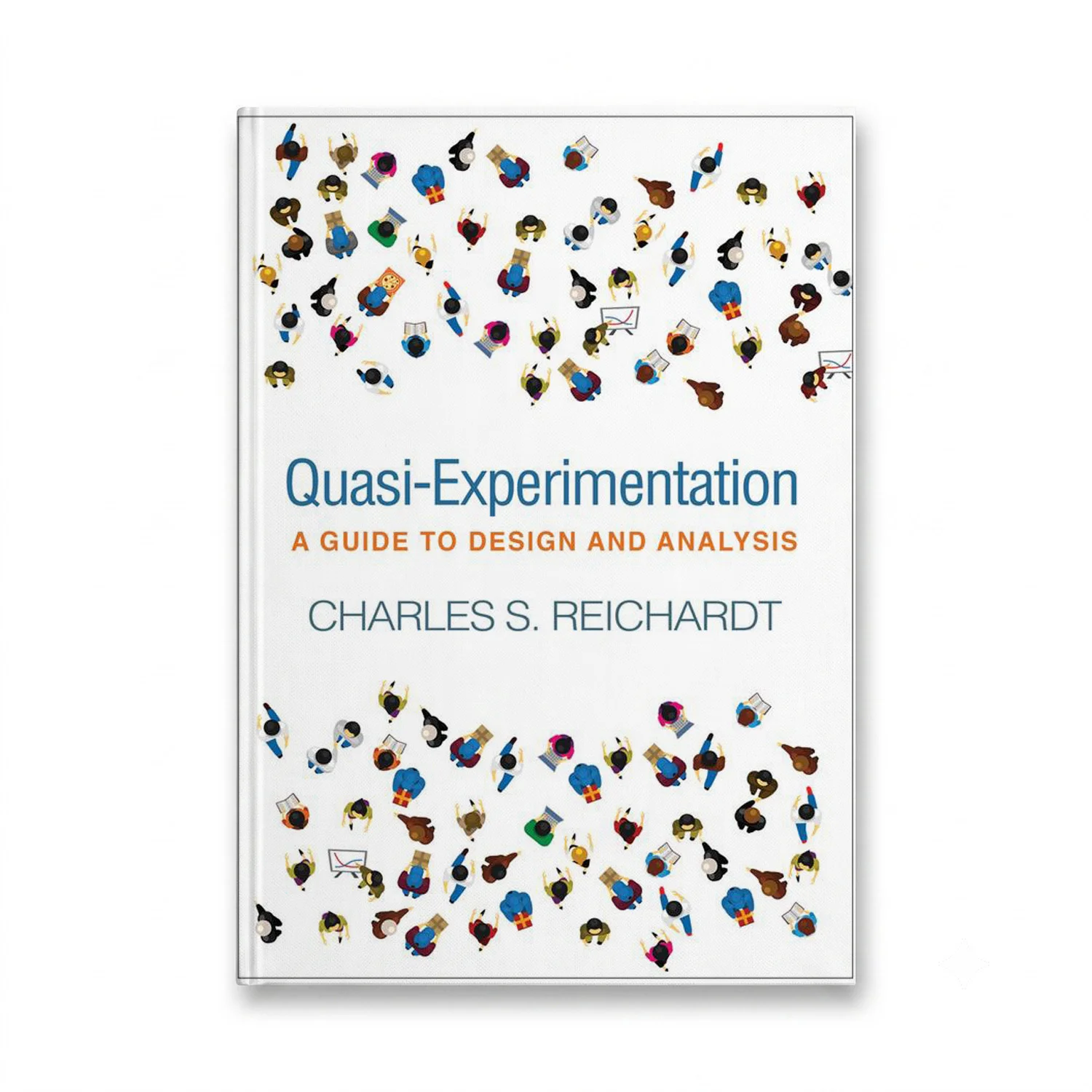

Quasi-Experimentation: A Guide to Design and Analysis (Methodology in the Social Sciences Series) delves into modern approaches to quasi-experimentation, offering practical insights for researchers navigating the complexities of field settings. Authored by Charles S. Reichardt, a foremost expert in the field, this comprehensive guide explores pretest–posttest, nonequivalent groups, regression discontinuity, and interrupted time-series designs. Each design’s strengths and weaknesses are meticulously analyzed, providing readers with valuable guidance on their application.
The book compares quasi-experiments to randomized experiments, discussing scenarios where quasi-experiments might be a superior choice due to practical contingencies. Reichardt discusses modern methods for mitigating bias in treatment effect estimates and offers strategies for handling missing data and noncompliance issues. To enhance accessibility, complex mathematical equations are translated into straightforward language.
Beyond the core discussion of prototypical quasi-experiments, this guide introduces a complete typology of quasi-experimental design options. This typology helps readers select the most appropriate research design for their specific study context, ensuring that their analysis remains both rigorous and practical.