
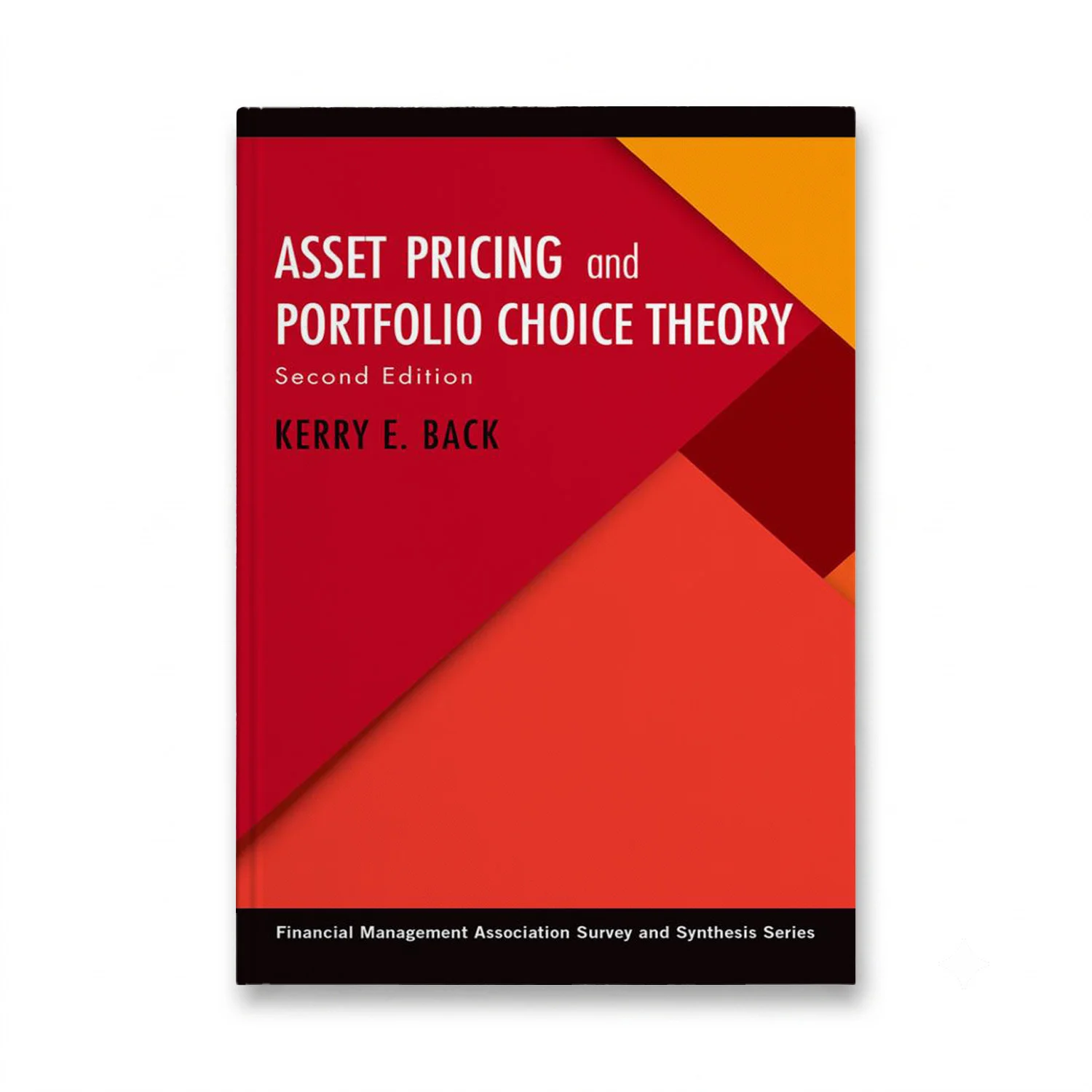

In the 2nd edition of Asset Pricing and Portfolio Choice Theory, Kerry E. Back provides a comprehensive introduction to asset pricing theory, suitable for advanced students in finance or quantitative finance at the Ph.D. or Master’s level. The book offers extensive exercises with a solutions manual available for professors, making it an ideal resource for academic settings. It is also highly valuable as a reference for financial researchers and professionals due to its detailed proofs and calculations included as section appendices.
The first two parts of the book delve into portfolio choice and asset pricing theory in various models: single-period, discrete-time, and continuous-time. Throughout these sections, the focus on valuation is centered around stochastic discount factors and their properties. A dedicated chapter covers derivative securities, including options, forwards, futures, term structure models, as well as applications to perpetual options in corporate debt, real options, and optimal irreversible investment.
The latter part of the book introduces contemporary topics such as rare disasters, long-run risks, external and internal habits, asymmetric and incomplete information, heterogeneous beliefs, and non-expected-utility preferences. Each chapter concludes with a “Notes and References” section that offers additional pathways to the literature, along with extensive exercises designed to reinforce learning.
With 744 pages of detailed content, this edition is an essential resource for anyone interested in deepening their understanding of asset pricing and portfolio choice theory.