
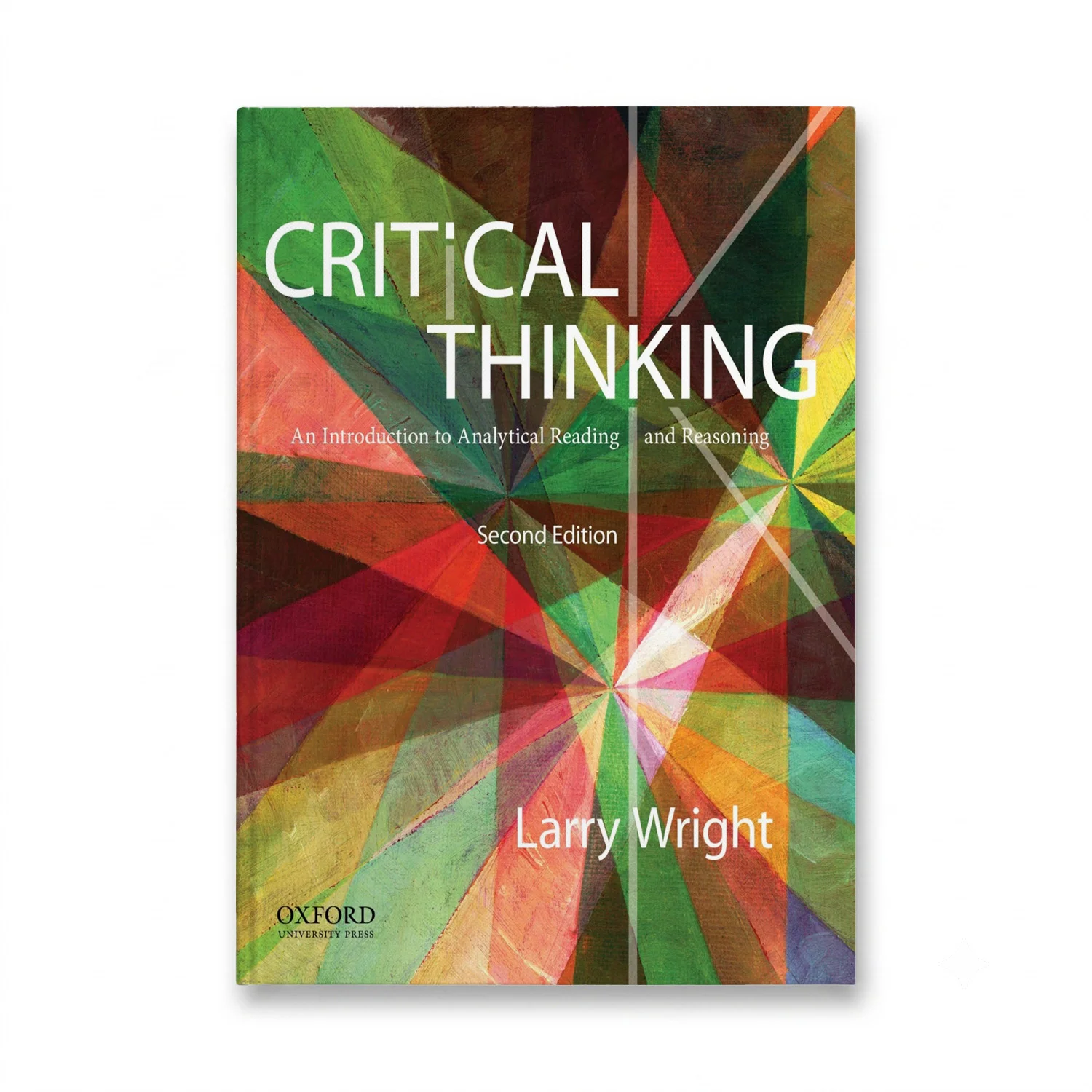

Critical Thinking: An Introduction to Analytical Reading and Reasoning, 2nd Edition
Author: Larry Wright
Publisher: Oxford University Press
Publication Date: October 29, 2012
ISBN-10: 019979622X
ISBN-13: 978-0199796229
Critical Thinking: An Introduction to Analytical Reading and Reasoning, Second Edition, provides a nontechnical vocabulary and analytic apparatus that guide students in identifying and articulating the central patterns found in reasoning and in expository writing more generally. Understanding these patterns of reasoning helps students to better analyze, evaluate, and construct arguments and to more easily comprehend the full range of everyday arguments found in ordinary journalism.
Distinguishing itself from other texts in the field, this Second Edition emphasizes analytical reading as an essential skill. It offers detailed coverage of argument analysis, diagnostic arguments, diagnostic patterns, and fallacies.
The book opens with two chapters dedicated to analytical reading, designed to help students recognize what explicitly differentiates reasoning from other expository activities. It then introduces an interrogative model of argument to guide analysis and evaluation of reasoning. This model facilitates a detailed articulation of “inference to the best explanation” and showcases the pervasiveness of this form of reasoning. The author illustrates how numerous common argument types—from correlations to sampling—can be effectively analyzed using this articulated form. Furthermore, the model is extended to address various predictive and normative arguments, demonstrating the utility of the fallacy vocabulary.
This essential resource is ideal for introductory courses in critical thinking, critical reasoning, informal logic, and inductive reasoning.