
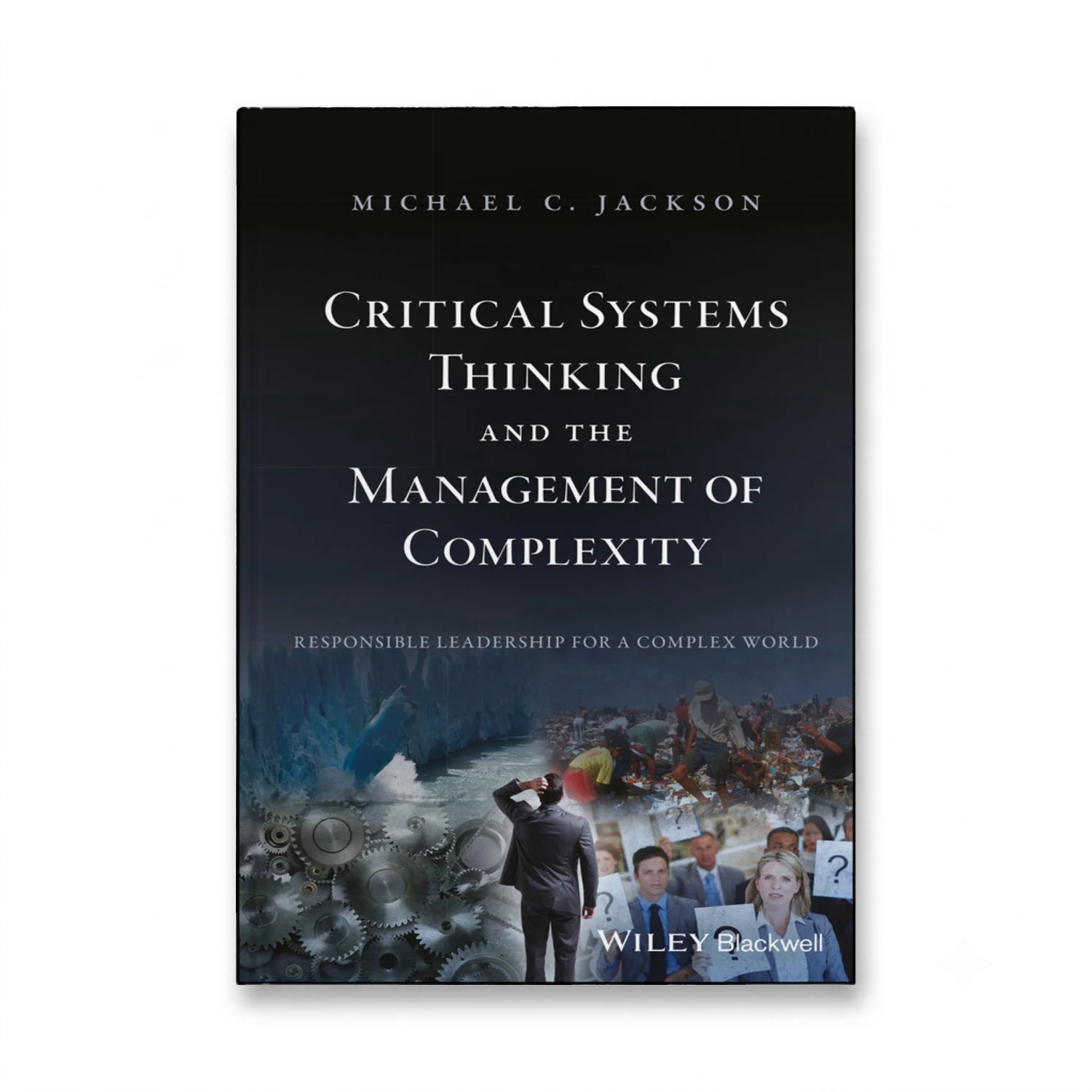

Critical Systems Thinking and the Management of Complexity
By Michael C. Jackson (Author)
1st Edition | English Language | Published by Wiley
Dimensions: 6.5 x 1.1 x 9.7 inches | ISBN-10: 1119118379 | ISBN-13: 978-1119118374 | Publication Date: April 15, 2019
Print Length: 736 pages
From the winner of the INCOSE Pioneer Award 2022
The world has become increasingly networked and unpredictable. Decision makers at all levels are required to manage the consequences of complexity every day. They must deal with problems that arise unexpectedly, generate uncertainty, are characterized by interconnectivity, and spread across traditional boundaries. Simple solutions to complex problems are usually inadequate and risk exacerbating the original issues.
Leaders of international bodies such as the UN, OECD, UNESCO, and WHO—and of major business, public sector, charitable, and professional organizations—have all declared that systems thinking is an essential leadership skill for managing the complexity of the economic, social, and environmental issues that confront decision makers. Systems thinking must be implemented more generally, and on a wider scale, to address these issues.
An evaluation of different systems methodologies suggests that they concentrate on different aspects of complexity. To be in the best position to deal with complexity, decision makers must understand the strengths and weaknesses of the various approaches and learn how to employ them in combination. This is called critical systems thinking. Making use of over 25 case studies, the book offers an account of the development of systems thinking and of major efforts to apply the approach in real-world interventions. Further, it encourages the widespread use of critical systems practice as a means of ensuring responsible leadership in a complex world.